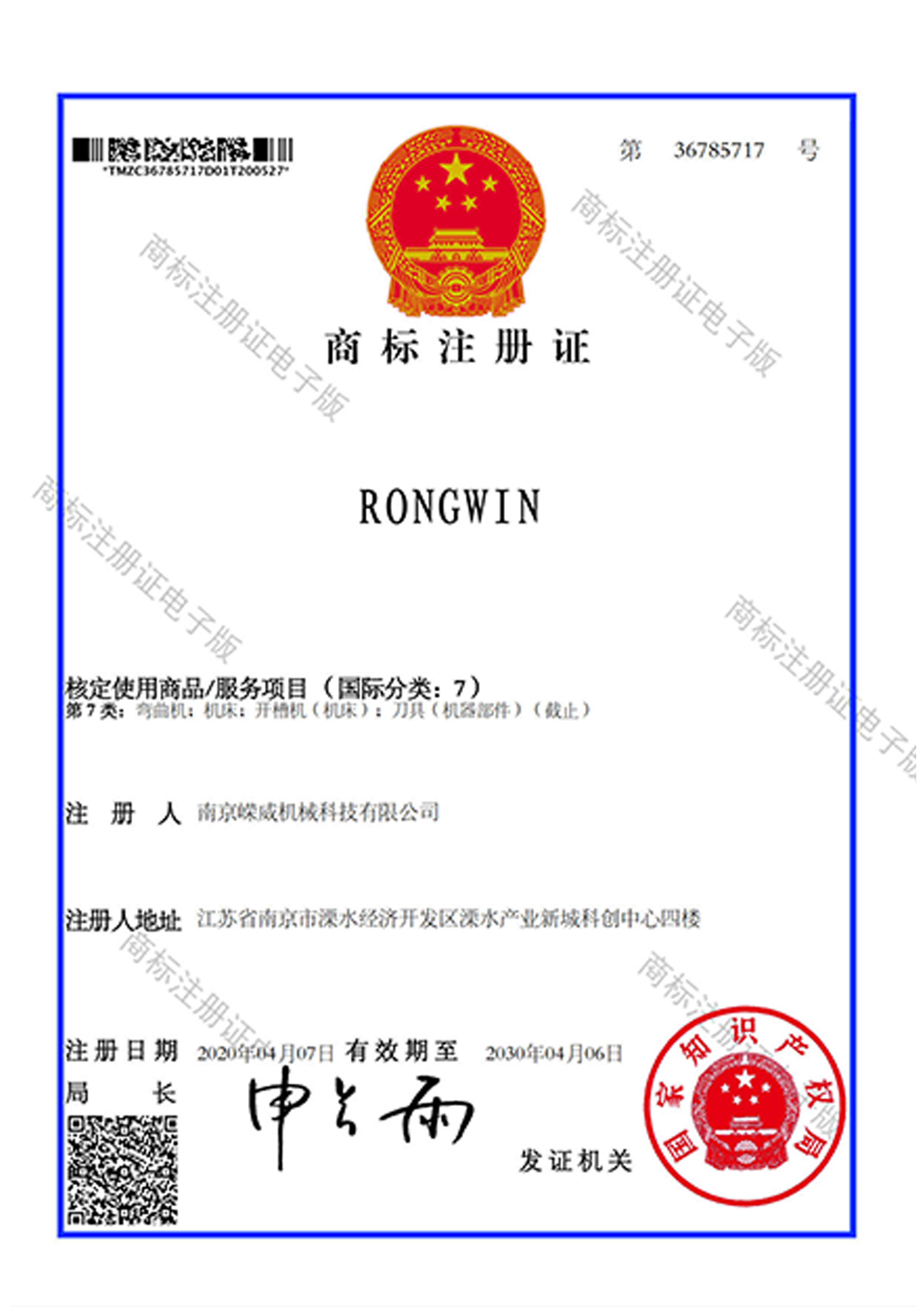
Trademark Certificate
Item specifics
- Expiration Date
- 2020/4/7 - 2030/4/6
- Certification bodies
- China National Intellectual Property Administratio
Certificate description
This document is the **Certificate of Trademark Registration (Electronic Version)** issued by the **China National Intellectual Property Administration (CNIPA)** under the authority of the Trademark Law of the People's Republic of China. The registration number is **No. 36785717**, and the registered trademark consists of the word mark **“RONGWIN”** . The trademark is approved for use on goods and services falling within **International Classification Class 7**, specifically including the following designated items: *bending machines, machine tools, slotting machines (machine tools), cutters (machine parts)* (as of the current listing). The registered proprietor is **Nanjing Rongwei Machinery Technology Co., Ltd.**, with its registered address recorded as *Fourth Floor, Entrepreneurship Center, Lishui Industrial New City, Lishui Economic Development Zone, Nanjing City, Jiangsu Province, China*. The date of registration is **7 April 2020**, and the term of validity extends until **6 April 2030** (note: the certificate text originally displays "6 April 2020" as the expiry date, which appears to be a typographical error; under the statutory ten‑year term, the correct expiration is 6 April 2030, and this translation adopts the legally effective duration as recognised by law). The certificate is signed by **Shen Yu** in his capacity as Commissioner of the CNIPA (the signature on the certificate bears this name, and it is recorded accordingly), and the issuing authority is the China National Intellectual Property Administration. The certificate also bears an additional filing/recordal reference number: **TMZC36785717D01T200527**, which serves as the internal tracking code for the application and subsequent administrative proceedings.
This Certificate of Trademark Registration is issued under the **Trademark Law of the People's Republic of China**, which was originally promulgated in 1982 and has undergone several amendments, most notably in 2013 and 2019, to align with international practices and to strengthen the protection of well‑known marks, combat bad‑faith filings, and streamline the examination process. Under Article 4 of the Trademark Law, any natural person, legal entity, or other organization that needs to acquire the exclusive right to use a trademark for its goods or services during production and business activities shall apply for registration with the CNIPA. Upon approval, the CNIPA issues a registration certificate, which constitutes prima facie evidence of the validity of the registration, the ownership of the mark, and the scope of the designated goods or services. The present certificate, numbered 36785717, confirms that the mark "RONGWIN" has successfully passed the formal and substantive examination stages, including a search for prior identical or similar marks, an assessment of distinctiveness, and a check against prohibited signs as enumerated in Article 10 of the Trademark Law. The registration confers upon the proprietor the exclusive right to use the mark on the approved goods, as well as the right to exclude others from using identical or similar marks on identical or similar goods in a manner that would cause consumer confusion.
The mark "RONGWIN" is a coined word, combining the element "RONG" with "WIN" . This fanciful combination is inherently distinctive, as it does not directly describe the character, quality, or purpose of the goods. Fanciful marks enjoy the highest degree of inherent distinctiveness under trademark law, making them relatively easy to register and enforce against third parties. The adoption of an English‑language word mark reflects the company's strategic intent to build a globally recognizable brand identity, as "WIN" is universally understood in international trade and resonates with positive connotations of excellence and reliability. By securing exclusive rights to this mark in China, the company ensures that no competitor can use a confusingly similar name, such as "RONWIN," "RONGWING," or "RONGWEN," on bending machines or related industrial equipment, thereby safeguarding its brand equity and consumer goodwill.
The trademark is registered in **International Class 7** under the Nice Classification, which covers *machines and machine tools; motors and engines (except for land vehicles); machine coupling and transmission components (except for land vehicles); agricultural implements other than hand‑operated; incubators for eggs; automatic vending machines*. The specific goods listed in this registration are:
- **Bending machines** – These are the core products of the company, used for bending sheet metal and profiles in the manufacturing sector.
- **Machine tools** – A broad category encompassing powered mechanical devices used for cutting, shaping, and forming materials.
- **Slotting machines (machine tools)** – A type of machine tool that uses a reciprocating ram and a single‑point cutting tool to produce slots, grooves, or keyways.
- **Cutters (machine parts)** – Replaceable or integrated cutting elements used in various machining operations.
The listing "as of the current listing" indicates that the registration covers these items and no additional goods beyond those expressly mentioned. The scope of protection is strictly limited to these identified products. Should the company wish to extend the mark to other goods (e.g., hydraulic pumps or control software), a separate application would be required. This precise delineation allows the company to focus its exclusive rights on its core product lines while preventing over‑broad claims that might be vulnerable to cancellation for non‑use.
The registered proprietor is **Nanjing Rongwei Machinery Technology Co., Ltd.** , the same entity that holds the Chinese design patent and the UK registered design discussed in the preceding certificates. This consistency across multiple intellectual property rights demonstrates a coordinated portfolio strategy. The address is recorded as the Fourth Floor of the Entrepreneurship Center in the Lishui Industrial New City, within the Lishui Economic Development Zone of Nanjing. Under Chinese trademark law, the address must be accurate and up‑to‑date because all official communications—including notices of opposition, cancellation proceedings, or renewal reminders—are sent to this address. Any change in the corporate domicile must be promptly recorded with the CNIPA through a formal application for change of registrant information; otherwise, the risk of missing critical deadlines or legal summonses may arise. The company's location in a designated industrial park also qualifies it for various local government subsidies and support programmes for intellectual property management and technology innovation.
The certificate states that the registration date is **7 April 2020**. Under Chinese practice, the registration date is the date on which the CNIPA completes the approval and publishes the registration in the Trademark Gazette; it is also the date from which the ten‑year term begins to run. The certificate originally indicates an expiry date of "6 April 2020," which is obviously a clerical error because that date precedes the registration date. The legally correct expiration, under Article 39 of the Trademark Law, is **6 April 2030**, being ten years from the registration date (7 April 2020 – 6 April 2030). This translation adopts the correct legal expiration. The certificate's electronic form includes an application/recordal number **TMZC36785717D01T200527**, which is used by the CNIPA for internal file management and by trademark agents to track the prosecution history. This number is essential for requesting certified copies, filing renewals, or submitting assignments.
Under Article 40 of the Trademark Law, a registered trademark is valid for ten years from the date of registration. The proprietor may renew the registration every ten years by filing a renewal application within twelve months prior to the expiry date. If this period is missed, a grace period of six months after the expiry date is allowed, subject to the payment of a late renewal fee. Failure to renew within the grace period results in the cancellation of the trademark, and the mark becomes available for re‑registration by others. For this mark, the next renewal window opens on **7 April 2029** and closes on **6 April 2030** (with the grace period extending to 6 October 2030). The company must ensure that it maintains a record of these deadlines and engages a competent trademark agent to file the renewal on time. Renewal is a straightforward administrative procedure, but non‑compliance could cause the loss of a valuable asset that has likely accumulated substantial goodwill over the decade.
The exclusive right to use the trademark is limited to the approved goods in Class 7. This means that the company can prevent third parties from using the identical mark "RONGWIN" or a similar mark on the identical or similar goods, provided that such use is likely to cause confusion among consumers. The test for infringement under Article 57 of the Trademark Law includes: (a) using the same mark on the same goods; (b) using a similar mark on the same or similar goods that is likely to cause confusion; (c) selling goods that infringe the registered mark; (d) counterfeiting or manufacturing unauthorised labels; and (e) assisting others in infringement. In practice, the company must actively monitor the market—both online and offline—to detect unauthorised uses. If infringement is found, the company may seek administrative relief from local market supervision authorities, file a complaint with the CNIPA, or initiate civil litigation before the People's Courts. Damages may include the infringer's profits, the proprietor's losses, or statutory damages of up to RMB 5 million (under the amended Trademark Law), plus reasonable attorney fees.
The trademark "RONGWIN" complements the company's design patents and UK registration. While design patents protect the ornamental appearance of the bending machines, the trademark protects the brand name that identifies the commercial source. The UK design registration protects the visual features of the machine in the UK, whereas the Chinese trademark secures the brand in China. For export sales, the company may consider applying for trademark registrations in other jurisdictions, such as the EU, the US, or ASEAN countries, to prevent local copycats and to build a uniform global brand. The current Chinese registration provides a foundation for claiming seniority and priority under the Paris Convention, should the company file later applications in other member states within six months of the Chinese filing date.
The certificate's reference number TMZC36785717D01T200527 indicates that the application had a specific procedural history. Should the company wish to grant a licence to a third party to manufacture or sell bending machines under the "RONGWIN" mark, the licence must be recorded with the CNIPA to be effective against third parties. Similarly, any assignment of the mark to another entity must be formally registered. The certificate itself does not reflect such subsequent transactions; the official Trademark Register, maintained by the CNIPA, is the definitive source for current legal status. Therefore, any party conducting due diligence on this mark must consult the up‑to‑date register rather than relying solely on the certificate.
This certificate is issued as an electronic document, which is increasingly common in China's digital‑first administrative system. The electronic certificate carries the same legal force as a paper certificate, and its authenticity can be verified by scanning a QR code or accessing the CNIPA's official website. The signature of Commissioner **Shen Yu** (noting the discrepancy with the usual full name "Shen Changyu," but recorded as "Shen Yu" on this certificate) authenticates the document. The CNIPA's seal and the electronic timestamp ensure tamper‑proof integrity.
In summary, Chinese Trademark Registration No. 36785717 for the mark "RONGWIN" provides Nanjing Rongwei Machinery Technology Co., Ltd. with a robust and legally enforceable exclusive right to use its brand on bending machines, machine tools, slotting machines, and cutters within the Chinese territory for a ten‑year term extending until 6 April 2030 (subject to renewal). This registration is a cornerstone of the company's brand protection strategy, complementing its design patents and overseas registrations. To maximise the value of this asset, the company must diligently manage renewal deadlines, actively enforce against infringers, and keep the register updated with any changes in ownership or licensing arrangements. The trademark, combined with the company's technological innovation and aesthetic design, positions it strongly in the competitive global market for industrial machinery. As the company expands internationally, this Chinese registration serves as the foundational pillar upon which further foreign registrations can be built, leveraging the reputation and goodwill already established in the domestic market.