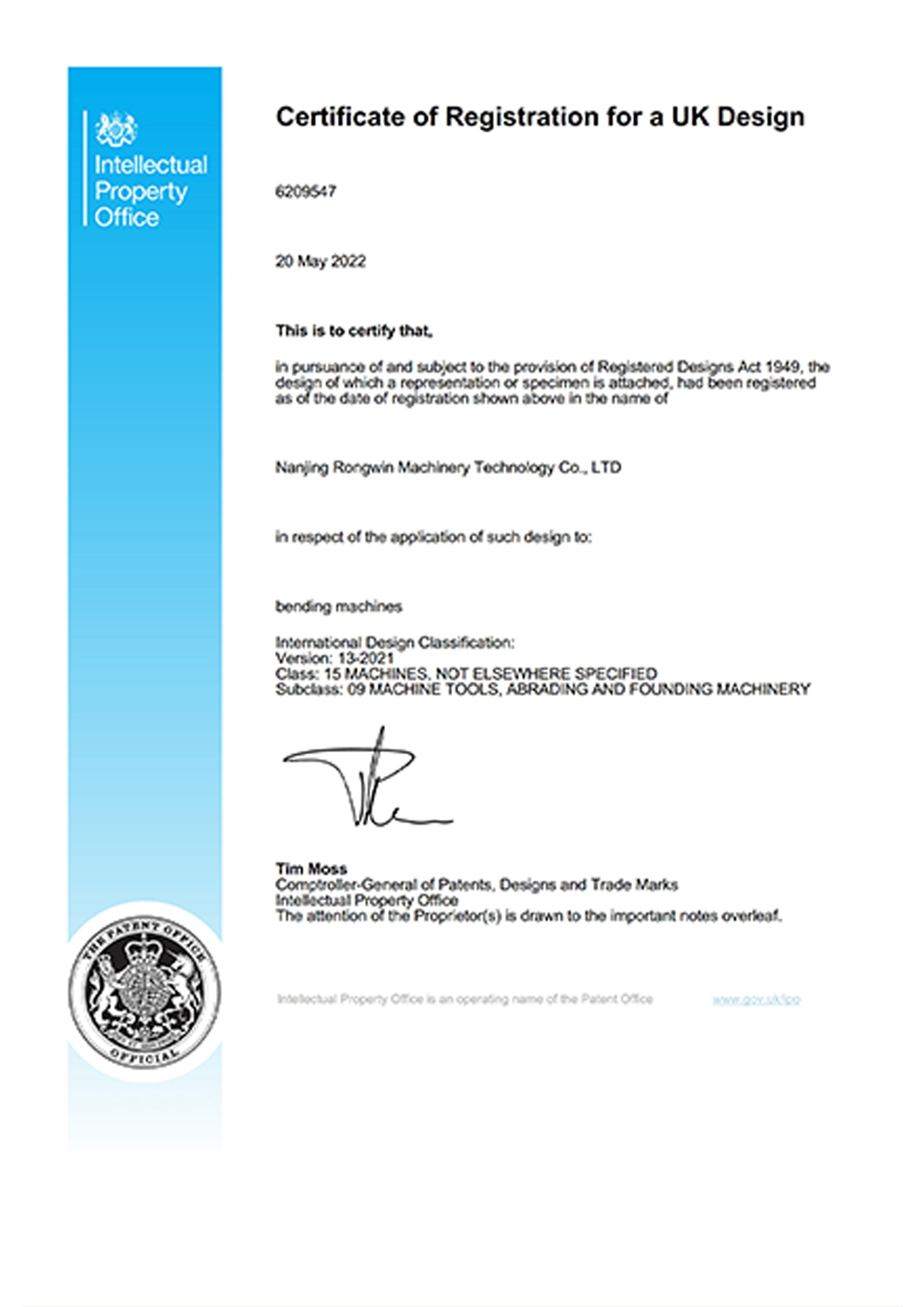
UK Design Patent Granted
Item specifics
- Expiration Date
- 2022/5/20 - 2042/5/19
- No.
- ZL202230342834.6
- Certification bodies
- UK Intellectual Property Office
Certificate description
This document serves as the **Certificate of Registration for a UK Design** (original title: Certificate of Registration for a UK Design), bearing the official registration number **6209547**, with a registration date of **20 May 2022**. The certificate is issued under the authority of the **Registered Designs Act 1949** (as amended) and is subject to all provisions, conditions, and limitations set forth in that Act and any subsequent statutory instruments, rules, or practice directions promulgated by the UK Intellectual Property Office (UKIPO). The certificate certifies that the design depicted in the accompanying representations (whether in the form of drawings, photographs, or specimens, as annexed to the certificate) has been duly registered with effect from the aforementioned registration date in the name of the registered proprietor, namely **Nanjing Rongwin Machinery Technology Co., LTD** (南京嵘威机械科技有限公司), a company organised under the laws of the People's Republic of China. The design is specifically applied to and embodied in the product category of **bending machines**, which fall within the industrial sector of metal-forming and sheet-working equipment.
This classification confirms that the design pertains to industrial machinery, more precisely to machine tools used in shaping metal workpieces through bending operations, which is a core technology in modern manufacturing.
The certificate is officially signed by **Tim Moss**, who holds the title of **Comptroller-General of Patents, Designs and Trade Marks** at the UK Intellectual Property Office. His signature and the official seal of the Office authenticate the instrument. The certificate also directs the attention of the proprietor and any interested parties to the important notes and conditions printed on the reverse side of the certificate, which contain essential legal information regarding the scope, duration, enforcement, and maintenance of the registered design right. The UK Intellectual Property Office is the operating name of the Patent Office and is a governmental agency under the Department for Science, Innovation and Technology. Its official website is provided as
The present UK design registration is governed by the **Registered Designs Act 1949** (hereafter "the Act"), which is the primary legislative instrument for the protection of industrial designs in the United Kingdom. The Act has been substantially amended over the decades, most notably by the Copyright, Designs and Patents Act 1988 and by subsequent regulations transposing European Union directives into UK law, and more recently by the amendments necessitated by Brexit. Despite the UK's withdrawal from the EU, the Registered Designs Act 1949 remains in full force, and the UKIPO continues to administer a standalone UK design registration system that operates independently of the EU Community design regime. Under Section 1 of the Act, a design may be registered if it is new and possesses individual character when assessed against the prior art available at the filing or priority date. The Act confers upon the registered proprietor the exclusive right to use the design and to authorise or prohibit third parties from making, offering, selling, importing, or stocking products incorporating the design without consent.
The certificate's issuance on **20 May 2022** indicates that the application was filed on that same date (or that a priority claim was duly made, although the certificate does not mention a priority claim). Under UK law, the registration date is generally the filing date, provided that all formal requirements are satisfied within the prescribed period. The effective term of protection for a UK registered design is **25 years** from the date of registration, subject to the payment of renewal fees every five years (at the fifth, tenth, fifteenth, and twentieth anniversaries). Unlike the Chinese design patent, which has a fixed non‑renewable term of 15 years (as previously discussed), the UK system allows a longer potential lifespan but imposes periodic maintenance obligations. Failure to pay a renewal fee by the due date, or within the subsequent six‑month grace period (with a surcharge), will result in the design lapsing and the rights ceasing.
The registered proprietor, **Nanjing Rongwin Machinery Technology Co., LTD**, is the same entity that holds the Chinese design patent discussed in the preceding certificate. This parallel registration strategy demonstrates the company's international commercial ambition, seeking to secure design protection not only in its domestic market but also in the United Kingdom, which remains one of the world's leading manufacturing and trading hubs. The slightly anglicised spelling "Rongwin" (as opposed to the pinyin "Rongwei") reflects a deliberate branding choice for overseas markets, facilitating pronunciation and brand recognition among English‑speaking customers and business partners. The company's core business—manufacturing CNC hydraulic bending machines—is capital‑intensive and highly competitive. Protecting the visual appearance of its machinery in the UK market prevents local competitors or importers from copying the distinctive ornamental features that may influence purchasing decisions in the premium segment of industrial equipment.
The design is registered for application to **bending machines**, which are classified under Locarno Class 15‑09. This classification is internationally recognised under the Locarno Agreement, to which the UK is a signatory. Class 15 covers "machines not elsewhere specified," and subclass 09 specifically addresses "machine tools, grinding and foundry machines." Bending machines, particularly CNC hydraulic variants, are essential in the automotive, aerospace, construction, and general sheet‑metal fabrication industries. The visual design of such machines includes the overall silhouette, the operator interface panel, the guarding systems, the hydraulic tank placement, the bed and ram configurations, and the colour and material contrasts. While the functional performance of the machine is determined by engineering parameters, the aesthetic design can significantly affect operator safety, ease of maintenance, and the brand's professional image. By securing a UK registration, the proprietor ensures that any unauthorised imitation of the machine's appearance—even if the internal mechanisms differ—can be challenged as an infringement of the registered design.
The certificate is signed by **Tim Moss** in his capacity as Comptroller-General of Patents, Designs and Trade Marks. This is a statutory officer appointed by the Secretary of State, responsible for the administration of the UK's intellectual property system. The Comptroller's signature and the official seal are conclusive evidence that the design has been examined (at least formally) and found to comply with the requirements of the Act. It is important to note that the UKIPO conducts only a limited examination for UK registered designs—primarily checking for formal compliance, clarity of representations, and whether the design falls within the statutory definition. Unlike the substantive examination for patents, the UKIPO does not ordinarily search prior designs to assess novelty or individual character. Therefore, the registration certificate does not imply that the design is definitively valid; rather, it grants a presumptive right that may later be challenged in invalidation proceedings before the UKIPO or the courts. This presumption of validity is rebuttable, and third parties may seek to cancel the registration on grounds such as lack of novelty, lack of individual character, or that the design is dictated solely by technical function.
Under Section 7 of the Registered Designs Act 1949, the registered design right confers the exclusive right to make, offer, put on the market, import, export, or use any product incorporating the design, or to stock such products for those purposes. The scope of protection extends to any design that does not produce on the informed user a different overall impression, taking into account the degree of freedom of the designer in developing the design. This "overall impression" test is applied by the courts, considering the similarities and differences between the registered design and the accused product, with particular attention to the visual elements that are not dictated solely by technical function. In the context of bending machines, the informed user would typically be an operator or purchasing manager with reasonable familiarity with such equipment. The protected design includes both the full product and, in certain cases, parts or components, provided they are separately visible and have their own ornamental characteristics.
The certificate explicitly reminds the proprietor to read the important notes on the reverse side. Those notes typically cover: (a) the requirement to renew the registration at five‑year intervals; (b) the possibility of recording changes in ownership, licences, or security interests in the UKIPO register; (c) the procedure for applying for a declaration of invalidity; and (d) the jurisdictional rules for enforcement actions. For a non‑UK resident company like Nanjing Rongwin, it is particularly crucial to appoint a UK‑based representative for service of legal proceedings and to ensure that renewal fees are paid in sterling, using the prescribed online or postal payment methods. Failure to adhere to these administrative procedures could result in the unintentional loss of rights. The proprietor is also advised to monitor the UK market for potential infringements, as the registered design provides a basis for customs seizure of counterfeit goods at UK borders, provided that a customs application is filed under the relevant regulations.
This UK registration, with its registration number 6209547 and date of 20 May 2022, is chronologically earlier than the Chinese design patent (which was filed on 7 June 2022). This suggests that the company prioritised international protection, possibly leveraging the UK's efficient registration system to secure an early filing date. Because the UK and China are both members of the Paris Convention for the Protection of Industrial Property, the company could have claimed a priority right within six months of the first filing in any member state. However, the certificate does not indicate any priority claim, so the UK filing date stands as the effective date for novelty assessment in the UK. By obtaining registrations in both jurisdictions, the company creates a protective fence that deters copying in two major economies, while also enhancing its valuation in due diligence exercises for potential investors or acquisition partners.
The UKIPO maintains a publicly accessible online register where anyone may search for this design by its number, proprietor name, or product classification. The register displays the current status (in force, lapsed, or invalid), the renewal history, and any recorded transactions. This transparency serves the public interest by enabling competitors to ascertain the scope of protected rights before launching new products, thereby reducing unintentional infringement and promoting orderly competition. The certificate itself, while a tangible evidence of registration, is not the definitive record; the digital register is the authoritative source for legal certainty.
In summary, UK Design Registration No. 6209547 represents a valuable intangible asset for Nanjing Rongwin Machinery Technology Co., LTD. It secures, under the Registered Designs Act 1949, exclusive rights over the ornamental appearance of bending machines for a potential period of 25 years, subject to timely renewals. The registration, signed by Comptroller‑General Tim Moss, confirms that the design has been formally accepted and entered into the official register as of 20 May 2022. The product classification under Locarno Class 15‑09 aligns it with machine tools, underscoring the industrial nature of the design. The proprietor must remain vigilant in maintaining the registration, enforcing its rights against infringers, and updating the register to reflect any changes in ownership or licensing. This certificate, together with the parallel Chinese design patent, forms a cohesive intellectual property portfolio that bolsters the company's competitive position in both the Asian and European markets. As the UK continues to develop its post‑Brexit IP framework, UK registered designs remain a robust and cost‑effective tool for industrial protection, and this registration exemplifies a strategic approach to global design asset management.