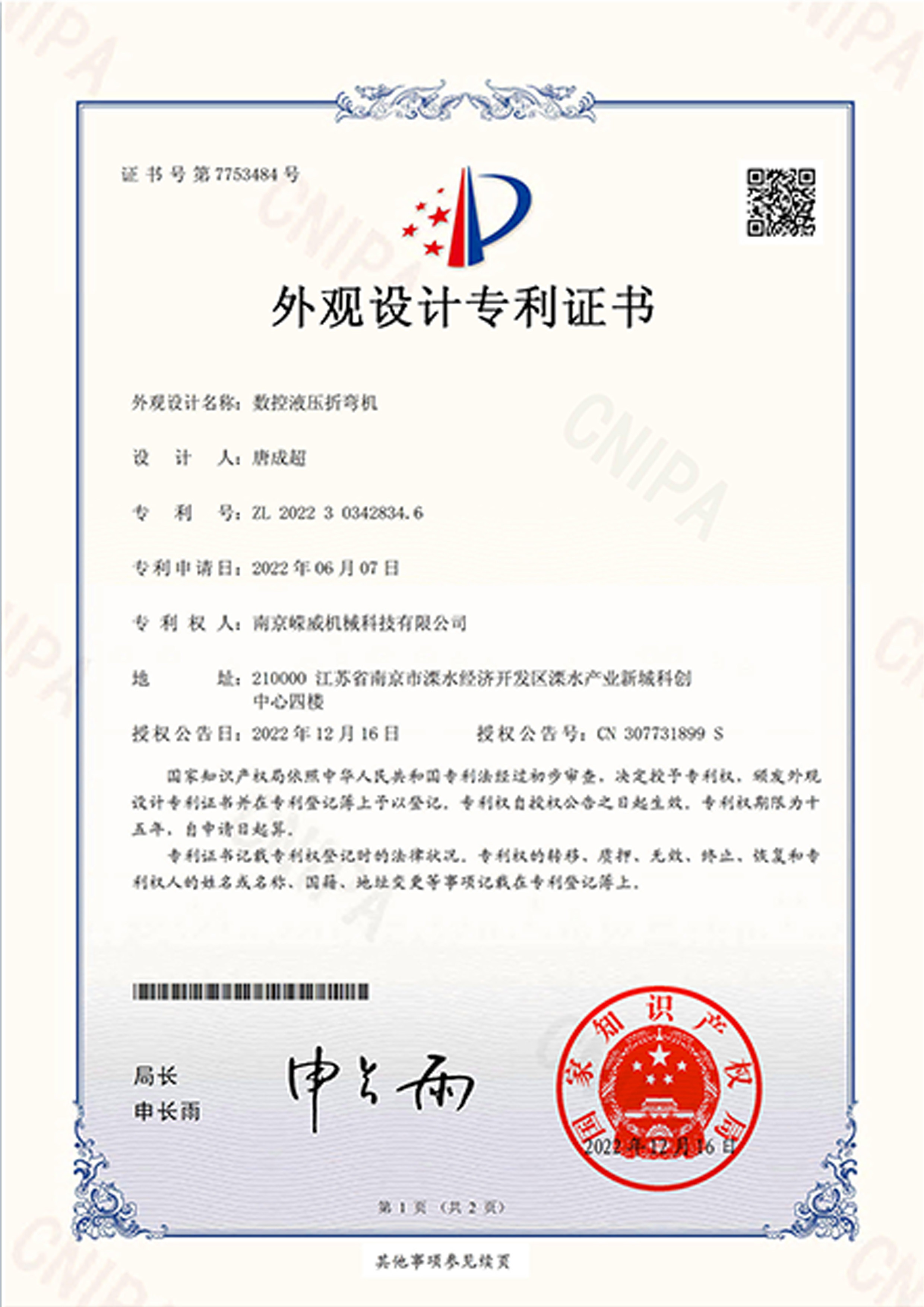
Design Patent Certificate
Item specifics
- Expiration Date
- 2022/12/16 - 2042/12/16
- No.
- ZL2022 3 0342834.6
- Certification bodies
- China National Intellectual Property Administratio
Certificate description
The present invention relates to an exterior design patent titled **"CNC Hydraulic Bending Machine"** . This design patent was conceived and completed by the sole designer, **Mr. Tang Chengchao**, who is recognized as the creative author under the provisions of Chinese patent law. The proprietary rights and ownership of this design patent are vested in the assignee and current patent holder, **Nanjing Rongwei Machinery Technology Co., Ltd.** , a legal entity duly organized and existing under the laws of the People's Republic of China. The patent is formally registered with the China National Intellectual Property Administration (CNIPA) under the official patent number **ZL202230342834.6**, which serves as its unique identifier in all official registers, public databases, and legal proceedings pertaining to intellectual property rights within China.
The formal application for this design patent was filed with the CNIPA on **June 7, 2022**. This date, known as the filing date or priority date under Chinese patent practice, is of paramount legal significance because it establishes the earliest effective date for determining novelty, prior art, and the statutory term of protection. Upon receipt of the application, the CNIPA conducted a formalities examination as mandated by the **Patent Law of the People's Republic of China**, specifically under the provisions governing design patents. Unlike invention patents, which require substantive examination, design patents in China are subject to a preliminary examination that assesses compliance with formal requirements, unity of design, clarity of drawings or photographs, and adherence to statutory subject matter eligibility. After a thorough review period lasting approximately six months, the CNIPA determined that the application met all statutory criteria and thus proceeded to grant the patent.
The official grant and publication of the patent occurred on **December 16, 2022**, on which date the patent was publicly announced in the China Patent Gazette. The corresponding authorization announcement number is **CN307731899S**, which is the official publication number under which the design representations—comprising line drawings, photographic views, or both—were made available to the public. Pursuant to Article 40 of the Chinese Patent Law, the patent rights take effect from the date of the announcement of grant. Consequently, **December 16, 2022** marks the effective date of enforceability, meaning that from this date forward, the patent holder possesses the exclusive right to exploit, license, assign, and enforce the design against any unauthorized third party that manufactures, offers for sale, sells, or imports products embodying the patented design within the territory of China.
Under the current legal framework established by the fourth amendment to the Chinese Patent Law, which took effect on June 1, 2021, the term of protection for design patents has been extended from ten years to **fifteen years**, counted from the filing date. Accordingly, the present patent enjoys a statutory term of fifteen years, commencing from **June 7, 2022**, and expiring on **June 6, 2037**, subject to the timely payment of annual maintenance fees as required by the CNIPA regulations. It is imperative to note that the duration is non-extendable and is strictly calculated from the filing date rather than the grant date. This extended term aligns China's design patent regime more closely with international standards, such as those under the Hague Agreement concerning the international registration of industrial designs, thereby providing longer market exclusivity for innovators in the industrial manufacturing sector.
**Patent Holder and Corporate Address**
The named patentee, Nanjing Rongwei Machinery Technology Co., Ltd., is a corporate entity operating within the machinery manufacturing and industrial automation industry. Its registered official address is recorded as **Fourth Floor, Entrepreneurship Center, Lishui Industrial New City, Lishui Economic Development Zone, Nanjing City, Jiangsu Province, China** (postal code: 211200). This location situates the company within one of Nanjing's key industrial development zones, which is known for hosting a cluster of advanced manufacturing enterprises, research institutions, and technology incubators. The Lishui Economic Development Zone is strategically positioned to support heavy machinery production, logistics, and export-oriented trade, which underscores the commercial relevance of this patent to the company's core business operations. The specificity of the address is legally significant because all official communications, renewal notices, and legal summons from the CNIPA or courts are served to this address; any change in the corporate domicile must be duly recorded in the patent register to ensure valid service of process.
The patent certificate, as issued by the CNIPA, serves as prima facie evidence of the existence and current legal status of the patent rights as of the date of issuance. However, the certificate explicitly contains a standard disclaimer indicating that it reflects only the legal state at the time of grant. The certificate is signed by the then-incumbent Commissioner of the CNIPA, **Shen Changyu** (申长雨), whose official signature and the seal of the office authenticate the instrument. The certificate consists of two pages in total; this description is based entirely on the content presented on the first page, which summarizes the core registration data, while the second page typically contains supplementary notes, drawing reproductions, or procedural history.
Crucially, the certificate notes that any subsequent changes affecting the legal status of the patent—including but not limited to **assignment of ownership, establishment of pledge or security interests, invalidation proceedings initiated by third parties, premature termination due to non-payment of maintenance fees, reinstatement after restoration, and any changes in the patentee's name, nationality, or registered address**—will not be reflected on the certificate itself. Instead, such events are recorded exclusively in the official **Patent Register** maintained by the CNIPA. The Patent Register is the authoritative, legally binding record that supersedes the certificate. In cases of inconsistency between the certificate and the Register, the Register prevails. Therefore, any party seeking to verify the current validity, ownership, or encumbrances of this patent must consult the up-to-date Register rather than relying solely on the physical certificate. This system ensures that the public has access to a dynamic and accurate source of information regarding the patent's lifecycle, which is essential for due diligence in commercial transactions, licensing negotiations, and litigation.
The patented design pertains to a **CNC (Computer Numerical Control) hydraulic bending machine**, which is a critical piece of equipment in the metal forming and sheet metal processing industry. Such machines are employed to bend sheet metal and plate material into predetermined angular profiles, utilizing hydraulic actuators controlled by computerized systems for precision, repeatability, and efficiency. The visual appearance of industrial machinery, while functional in primary purpose, often incorporates distinctive design elements that enhance operator safety, ergonomic access, cooling efficiency, and aesthetic branding. This design patent protects the ornamental features—such as the overall configuration of the frame, the arrangement of control panels, the housing contours, the positioning of hydraulic cylinders, the guarding systems, and the interface layout—that distinguish this machine from competing products in the marketplace. Securing design protection for such industrial equipment is commercially vital because it prevents competitors from copying the visual trade dress, which can create brand recognition and customer loyalty in a capital-intensive industry where equipment purchases involve significant investment and long-term operational commitments.
During the preliminary examination, the CNIPA examiners assessed whether the design satisfied the requirements of novelty (not being identical or similar to any design publicly disclosed before the filing date), originality (being significantly different from existing designs when viewed from the perspective of an informed user), and compliance with statutory formalities, including proper preparation of drawings showing six orthographic views (front, rear, left, right, top, bottom) and a perspective view, with clear shading or contour lines indicating three-dimensional features. The application was also reviewed for unity—ensuring that it contains only a single independent design. Having passed these hurdles, the application proceeded to grant without any office actions or rejections, which suggests that the design was well-prepared and clearly distinguishable from the prior art.
Upon the effective date of grant, the patentee has the right to exclude others from making, using, offering for sale, selling, or importing the patented design product. To maintain the patent in force throughout its fifteen-year term, the patentee must pay annual renewal fees (often referred to as maintenance fees) to the CNIPA before the anniversary of the filing date each year. Failure to pay these fees within the prescribed grace period (typically six months with surcharges) will result in the termination of the patent rights, rendering the design dedicated to the public domain. The patentee is also responsible for monitoring the market for potential infringement and for taking appropriate legal action, whether through administrative enforcement before the CNIPA or through civil litigation before the People's Courts, against any unauthorized use of the protected design.
In summary, this certificate represents not merely a piece of paper but a formal grant of monopoly rights conferred by the sovereign state in recognition of the designer's creative contribution to the field of industrial machinery design. It embodies the balance between public disclosure and private exclusivity—the patentee receives exclusive rights in exchange for fully disclosing the design in the public record, thereby enriching the pool of technical and aesthetic knowledge available to future innovators. The detailed information recorded on this certificate, including the patent number, filing date, grant date, term, designer, patentee, and address, collectively constitute the foundational metadata that enables the patent system to function transparently and predictably. For stakeholders—including investors, business partners, competitors, and legal practitioners—this certificate is the starting point for any comprehensive intellectual property due diligence. However, as the certificate itself cautions, it is not the final word; the dynamic nature of patent ownership and validity necessitates continuous consultation of the Patent Register. This dual-layered system of documentation (certificate plus register) ensures both initial certainty and ongoing accuracy, thereby upholding the integrity of the patent system and promoting industrial progress—a core objective enshrined in Article 1 of the Chinese Patent Law.
In conclusion, the patent certificate for ZL202230342834.6 represents a legally robust and commercially significant asset for Nanjing Rongwei Machinery Technology Co., Ltd., securing exclusive rights over a distinctive industrial design for a full fifteen-year term, with all attendant rights and obligations clearly delineated under Chinese intellectual property law. The proper understanding and management of this patent, including timely fee payments, diligent market surveillance, and accurate recordal of any legal changes, will be essential to maximizing its strategic value in the competitive machinery manufacturing sector.