The Science of Automated Bending: The Complete Engineering Guide to RWP-Robot Press Brake Cells
- Share
- publisher
- Daisy Li
- Issue Time
- Oct 23,2026
Summary
Explore how the RWP-Robot solves labor shortages, ergonomic risks, and quality bottlenecks in press brake bending. This comprehensive 2026 engineering guide covers 6-axis kinematics, pneumatic vacuum matrix physics, real-time dynamic sheet-following algorithms, and a complete TCO ROI economic model for 24/7 lights-out sheet metal fabrication.
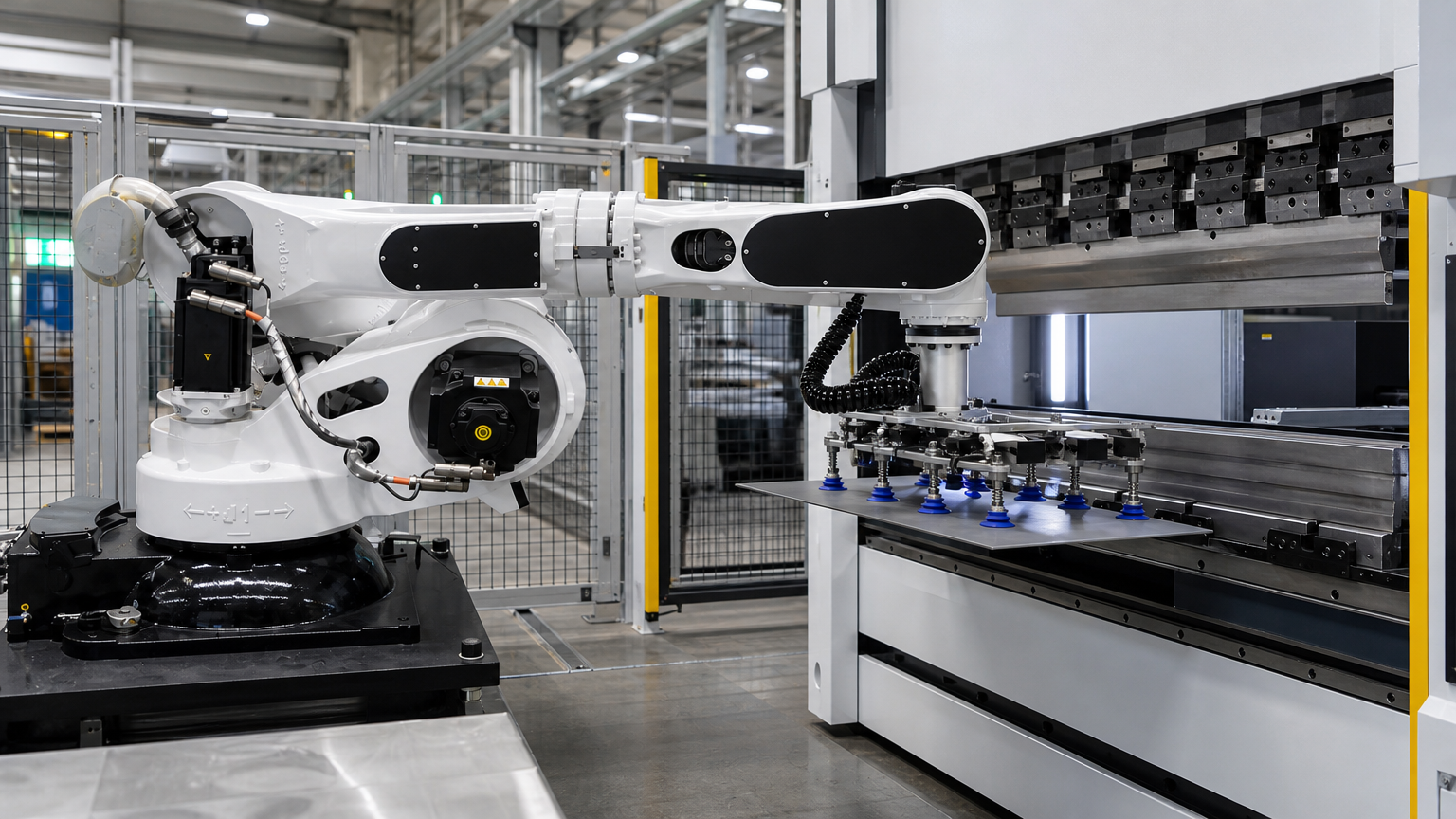
An In-Depth Technical Guide to 6-Axis Kinematics, Pneumatic Vacuum Dynamics, Real-Time Sheet-Following Science, and ROI Economics
1. Executive Summary & The Manufacturing Dilemma
In the modern smart manufacturing landscape, sheet metal fabrication has undergone an unprecedented transformation. High-power fiber laser cutting centers and high-speed CNC punching systems routinely operate in fully automated, 24/7 "lights-out" shifts. However, once cut blanks reach the bending stage, factory throughput frequently grinds to a halt.
Manual press brake operation represents the single greatest bottleneck in contemporary metal forming:
1.Severe Labor Scarcity & High Wage Pressure: Bending requires experienced operators with years of spatial tactile training. Retaining qualified technicians is an acute global industry challenge.
2.Ergonomic Strain & Workplace Hazards: Operators handling 10 kg to 50+ kg sheets suffer from repetitive spinal strain. Working in close proximity to high-tonnage hydraulic and servo pinch points presents constant occupational safety risks.
3.Fatigue-Driven Quality Inconsistency: As human operators fatigue across an 8-hour shift, part positioning repeatability against backgauge stops degrades, resulting in angular variances and scrap rates of 3% to 5% on complex multi-bend parts.
4.Low Machine Utilization: Shift changeovers, rest breaks, and manual part re-gripping limit actual press brake beam utilization to less than 40%–50% of available factory hours.
The RWP-Robot press brake automation cell by RONGWIN delivers a scientific, cyber-physical solution to these manufacturing challenges. By pairing a heavy-duty 6-axis articulated industrial robotic arm with reconfigurable multi-zone vacuum suction grippers, closed-loop CNC dynamic sheet-following algorithms, and automated offline 3D programming, the RWP-Robot converts standalone press brakes into fully autonomous, high-precision, 24/7 lights-out bending workcells.
This engineering guide provides a comprehensive technical exploration of the RWP-Robot's kinematic architecture, vacuum physics, dynamic trajectory interpolation, full operational comparisons, and a proven financial ROI calculation model.
2. Robotic System Architecture & 6-Axis Kinematic Principles
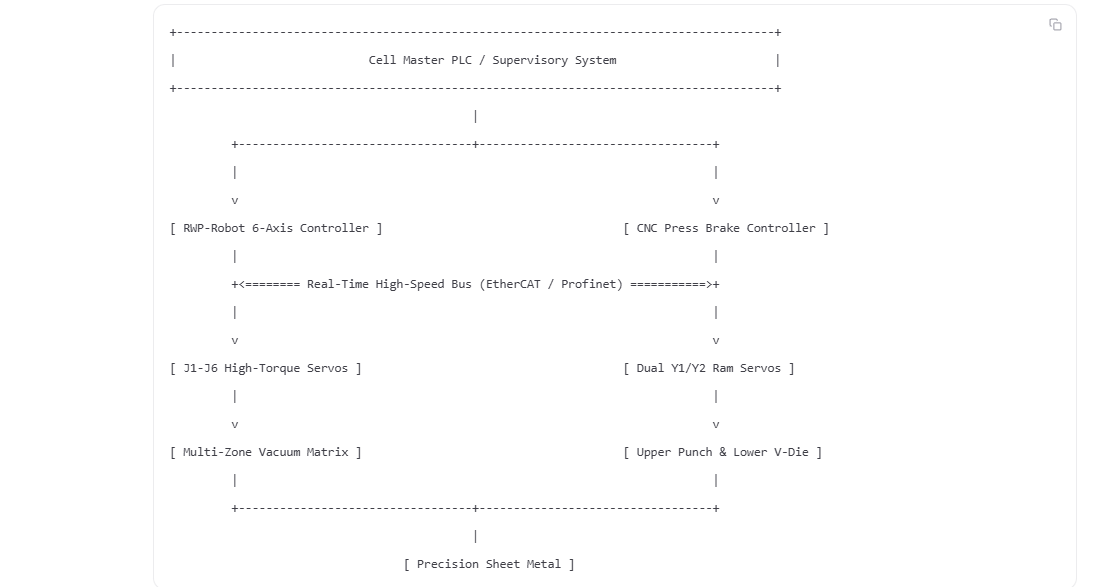
2.1 6-Axis Articulated Kinematic Degrees of Freedom
The RWP-Robot is built on an industrial 6-axis serial articulated arm architecture. Each revolute joint (J1 through J6) is driven by high-torque AC brushless servo motors coupled to zero-backlash precision RV cycloidal or harmonic drive reducers with 23-bit absolute optical encoders:

2.2 The Physics of Dynamic Sheet-Following Tracking
The core scientific challenge of robotic press brake bending occurs during the active plastic deformation stroke. As the upper punch presses the sheet metal blank into the lower V-die, the protruding sheet flange rotates rapidly upward along an expanding circular arc.
If the robot holds the sheet rigidly, the immense bending tonnage will buckle the sheet or damage the robotic arm. If the robot unclamps, gravity causes the sheet to sag, causing angular distortion and surface scratches.
The RWP-Robot solves this challenge via Real-Time Dynamic Sheet-Following Trajectory Interpolation:
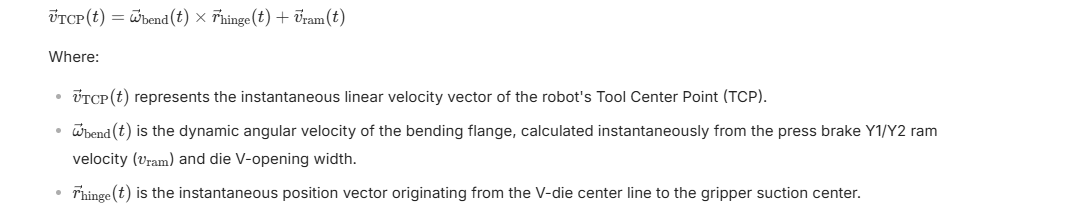
Through ultra-fast EtherCAT/Profinet communication with the press brake CNC, the robot interpolates its J1–J6 joint coordinates at millisecond intervals, smoothly floating with the sheet during forming with zero back-bending, zero slippage, and zero surface marking.
3. Physics of the End-Effector: Multi-Zone Pneumatic Vacuum Matrix
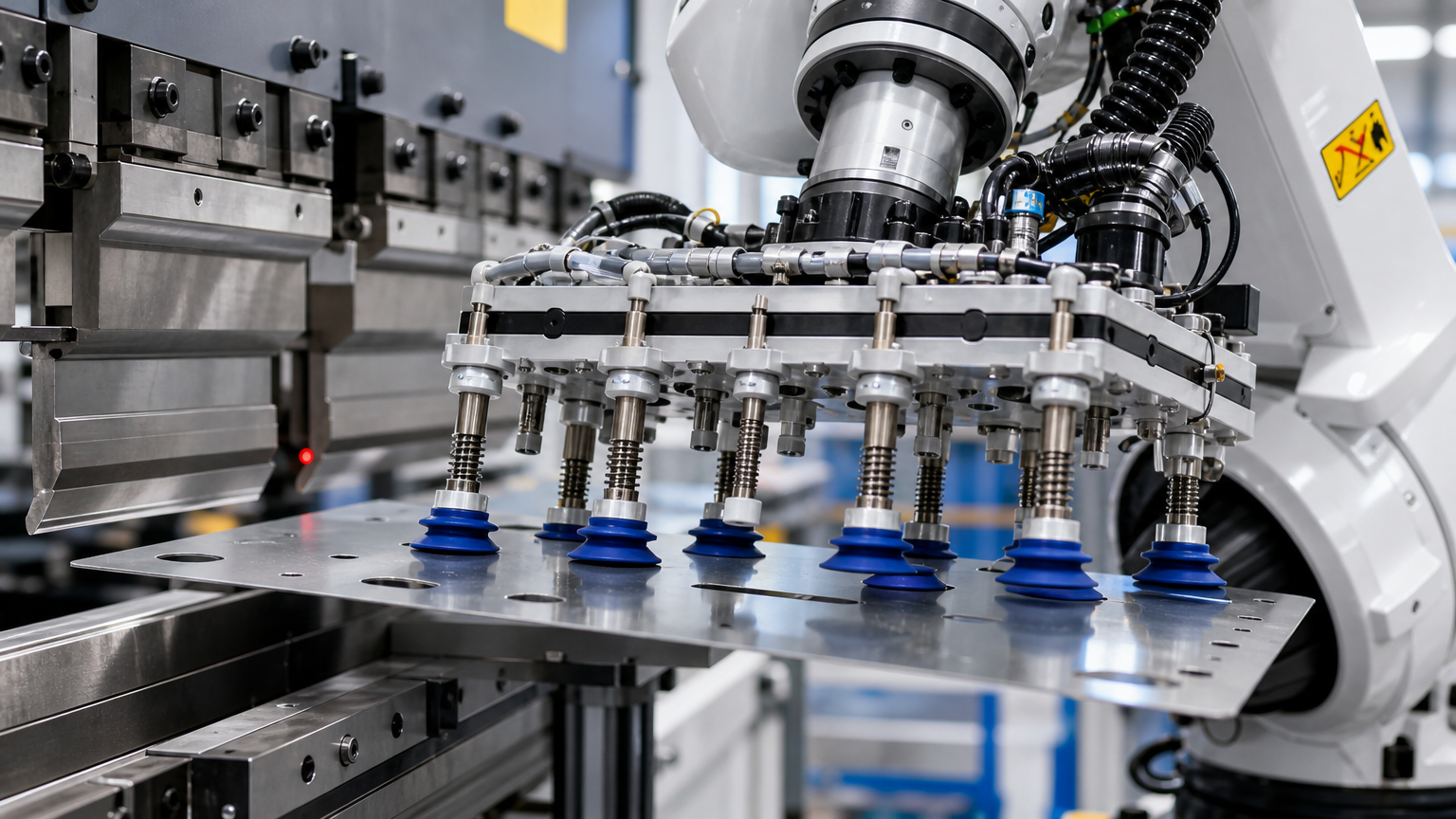
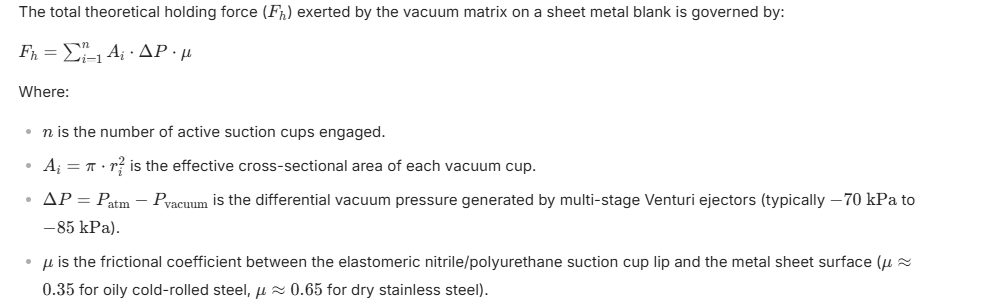
3.1 Venturi Vacuum Dynamics and Holding Force Equations
The RWP-Robot utilizes a modular multi-zone pneumatic vacuum suction matrix end-effector engineered specifically for high-speed sheet metal transfer.
3.2 Advanced End-Effector Engineering Capabilities
1.Multi-Zone Independent Solenoid Control: Individual vacuum circuits can be selectively energized or isolated via CNC software. This allows the same gripper to handle small
100×100 mm electrical brackets or expansive 2500×1200 mmelevator door panels without manual gripper changeover.
2.Integrated Mechanical Clamping Assist: For narrow flanges, perforated sheets, or heavy parts where vacuum area is restricted, pneumatically actuated mechanical edge clamps engage automatically to provide positive mechanical locking.
3.Double-Sheet Magnetic Separation & Ultrasonic Sensing: Integrated ultrasonic sensors verify that exactly one blank is picked from the infeed stack, preventing multi-sheet feeding and catastrophic tooling collisions.
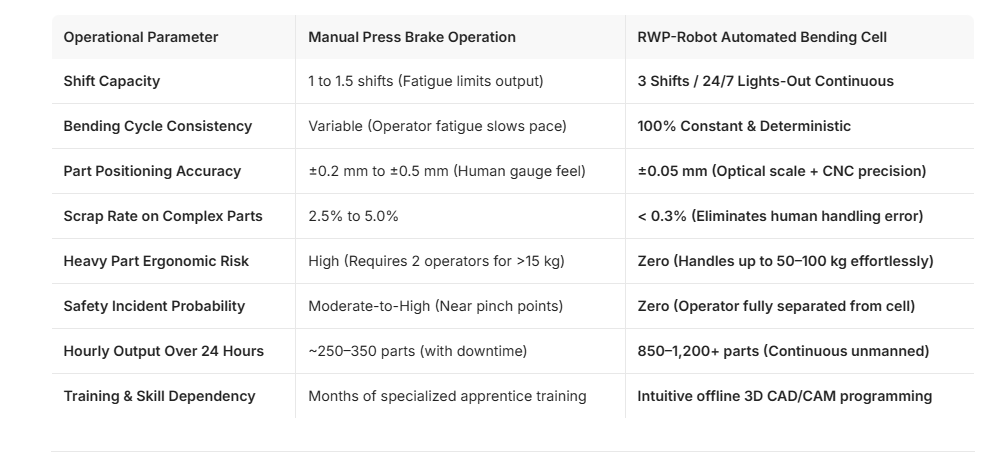
4. Comprehensive Comparison: Manual Bending vs. RWP-Robot Automated Cell
The operational transformation delivered by the RWP-Robot is demonstrated in the direct comparison below:
5. Workcell Layout & Integrated Peripheral Stations
A complete RWP-Robot automated press brake cell operates as a fully integrated, flexible manufacturing system comprising five coordinated peripheral stations:
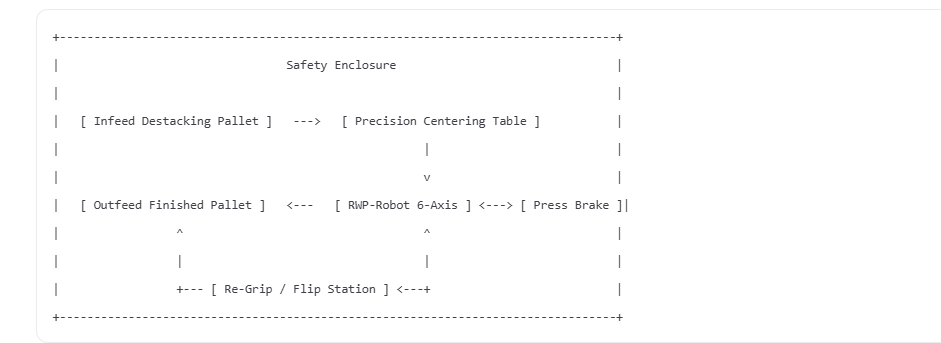
1.Infeed Destacking Station: Equipped with permanent magnetic sheet fanners and high-pressure air-knife nozzles to prevent sheet adhesion.
2.Precision Gravity/Optical Centering Table: The robot deposits raw blanks onto an inclined reference table with pneumatically retractable datum pins to establish exact zero-reference coordinates prior to insertion into the press brake.
3.Re-Grip & Turnover Station: For complex multi-bend enclosures (such as deep 4-sided electrical cabinets), the robot clamps the semi-finished part onto an intermediate stand, repositions its gripper, or performs a 180° inverted turnover maneuver.
4.CNC Press Brake Handshaking Interface: Bidirectional optical interlocks prevent press brake ram movement until the robot signals "In Position," and prevent robot retraction until the ram reaches decompression height.
5.Outfeed Palletizing & Stacking Station: Finished parts are systematically stacked onto pallets according to programmed tessellation patterns or placed onto outgoing transfer conveyors.
6. Wide Range of Applicable Sheet Metal Workpieces
The RWP-Robot automated cell excels across an expansive range of industrial sheet metal components:
1.Electronic Enclosures & Server Chassis: Multi-bend precision brackets, server power supply housings, and telecom cabinet sub-assemblies.
2.HVAC & Appliance Panels: Air conditioner outer casings, heat exchanger frames, and domestic oven liners.
3.Elevator & Architectural Panels: Large-format stainless steel elevator door skins and architectural cladding brackets.
4.Automotive & Transportation Brackets: Heavy-gauge structural mounting plates, battery tray reinforcement ribs, and chassis cross-members.
7. Economic Modeling & Total Cost of Ownership (TCO) ROI Analysis
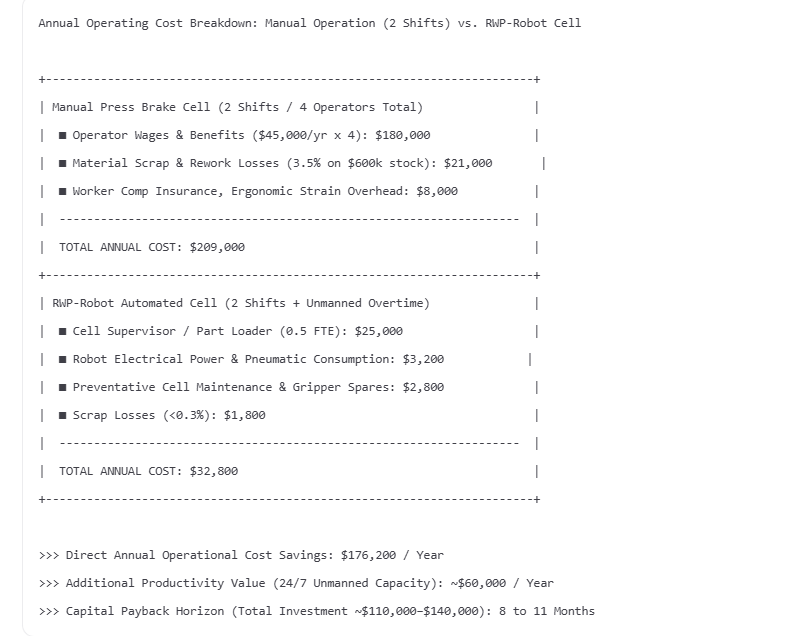
The financial return on investment for the RWP-Robot is demonstrated through a standard industrial fabrication business model:
7.1 Real-World Economic Calculation Model
Assume a medium-sized metal workshop producing 200,000 bent parts annually across two operational shifts:
7.2 Core Financial Drivers:
1.Direct Labor Reallocation: Reduces direct brake labor by 80% to 90%, allowing skilled personnel to be redeployed to high-value programming and quality control.
2.Rapid Capital Payback: Payback is achieved in under 12 months on 2-shift operations, and under 8 months on 24/7 continuous operations.
3.Predictable Quoting & Delivery: Fixed robot cycle times eliminate quoting uncertainty, enabling fabricators to win competitive export contracts with guaranteed lead times.
8. Offline 3D CAD/CAM Simulation & Fast Batch Changeover
Traditional robotic automation required days of manual teach-pendant programming, idling expensive machinery during changeovers.
The RWP-Robot ecosystem integrates intuitive 3D Offline CAD/CAM Bending Simulation Software:
1.Automated Tooling & Sequence Calculation: Imports native 3D STEP/IGES CAD models, calculates optimal punch and die tooling layouts, and derives collision-free bending sequences.
2.Automated Robot Trajectory Generation: Automatically generates complete 6-axis robot motion paths, centering routines, regrip sequences, and palletizing patterns.
3.Full Virtual Collision Detection: Simulates the entire cell in virtual 3D space to detect potential interference between the gripper, press brake frames, backgauge fingers, and workpiece before cutting physical metal.
4.Instant Program Deployment: Uploads verified G-code and robot motion trajectories over the factory network, reducing physical batch changeover times to under 10 minutes.
9. Conclusion: The Foundation of the Smart Autonomous Sheet Metal Factory
The RWP-Robot (RW-A Series) press brake automation cell bridges the gap between manual sheet metal forming and next-generation Industry 4.0 automation. By replacing ergonomic strain, safety vulnerabilities, and labor bottlenecks with micron-level robotic precision and relentless 24/7 productivity, the RWP-Robot empowers sheet metal manufacturers to scale output, eliminate scrap, and maximize gross margins.
In modern manufacturing, robotic bending automation is no longer a luxury upgrade—it is the foundational standard for profitable, sustainable sheet metal fabrication.